 day 59
|
behind apple's blunder 1: the apple advantage
by Philip Machanick
|
|
In the second half of 1995, I was convinced
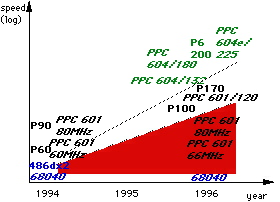
that Apple was heading for a great year. The Pentium Pro (or P6) was reported to run 16-bit code slowly -- so slowly that it was useless for Windows 95. The PowerPC 604 was shipping, and delivering great performance. Apple had two other undeniable advantages: a plug and play architecture, and a loyal customer base. Plug and play is not a feature that can be retrofitted -- it's an overall architectural philosophy. Windows is like a rickety old house that has been added to by a dozen successive owners, each with less taste than the last. You cannot turn such a house into an architect-designed marvel by adding an "architect-designed" feature. When Windows 95 was introduced in min-1995, the Mac OS was already a true 32-bit system, capable of using latest-generation processors to full effect. And it is impossible to understate Apple's fiercely loyal customer base, which had stuck with the Mac even when its performance dipped well below the curve (see figure).
The question as the second half of 1995 dawned was this: could Apple turn its advantages into real growth in market share? We'll have the answer tomorrow. |
 Daily Dose Index |