 day 83
| digital darwinism 5: accidental empires |
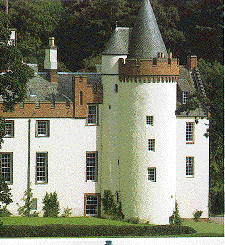
Eye Candy #4: Except for a heavy bombing in WWII and a
Yesterday we learned that the computer industry
is a jungle of Darwinian architectures.
"The boys of Silicon Valley make their
millions, battle foreign competition, and still
can't get a date." If this does not prove that
the computer industry is a messy place governed
by serendipity, ruined plans, and machine-gun
artists, then I will have to convince you with
a more detailed technical argument. Here goes.
descendant of the inventor of the Swiss Army
knife, supervises 900 workers who churn out
110,000 knives per day. In 1909
great-grandfather Karl Elsener named the
company "Victoria" after his mother, but
he changed it to "Victorinox" when stainless
steel was invented in the 1920s ("inox" refers
to stainless steel). With the exception of this
small perturbation, Victorinox has been
replicating the same design since the 1890s.
architecture that permits tools such as can
opener, screwdriver, nail file, and toothpick
to easily be mixed and matched in 800 different
variations of the same design. In short, the
Swiss Army knife has a solid architectural
basis leading to a solid design that has made
millions for the Elseners. The architectural
underpinnings were so good that there has been
little to change in 100 years. The Swiss Army
knife hits the bull's-eye like a rifle shot.
|
digital darwinism
 1
2
3
4 1
2
3
4
 Daily Dose Index |