 day 31
| the end of microsoft 3: cut and slash |
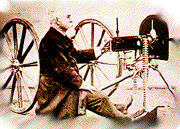 Figure 3: Sir Hiram Maxim's first invention failed: his 105-foot airplane crashed at the end of the 1,800-foot runway. His second invention was much more successful. The machine gun has contributed to a lot of cut and slash.
two different things." Cutting is decisive, with spirit; slashing is nothing more than touching the enemy. Microsoft has gone soft-- it is slashing instead of cutting. Here is some evidence. First, look at where their money comes from: about half from licensing Windows operating systems, and about half from MS Office (actually, $1B of the $2.2B came from Office). It is truly amazing how little product MS has. One slip in Windows95 and/or NT, and the company could be forced to slash its workforce-- or else come up with 50% of its revenues from elsewhere. Another slip in Office, and the company would be looking for assistance from the Federal government (remember Chrysler?). When describing the MS Office dependency, Mike Brown, CFO of Microsoft, admits, "We have the issue of saturation there" (http://techweb.cmp.com/iw, or Information Week, April 23, 1996, p. 32). He told Wall Street gurus that Office sales got a boost from the introduction of Windows95, which stimulated replacement sales of Office. What will MS do next summer without an upgrade to Windows95? Where will it find $1B in Office sales? Second, look at how MS is painting itself into a corner. It is becoming increasingly proprietary. Although they renamed OLE to ActiveX, it is still a Microsoft solution that works only on Windows platforms. Reluctantly moving ActiveX to the Macintosh does not make Microsoft a systems solution house. By snubbing its nose at OMG's CORBA and CILab's OpenDoc, MS is becoming the grumpy old man of the software biz. Third, what about Visual BASIC? This tiny application development platform has perhaps 3M users, but is the most extreme proprietary point solution product one could imagine. Compare VB to PowerBuilder, which runs on just about everything and is designed to implement industrial-strength client/server applications. Get even more serious and compare VB with ParcPlace's VisualWorks, and you have to wonder why VB is used at all. Tomorrow we look at the second challenge facing stodgy Microsoft. Is there a warrior out there that is even faster than MS? Has MS's time come? |
the end of microsoft:
 1
2
3
4
5 1
2
3
4
5
 Daily Dose Index |