 day 87
| digital darwinism 9: creep |
|
Yesterday we saw that Dynamic Linking and
Embedding (DLE) evolved into Object Linking and Embedding (OLE) which evolved into ActiveX. None of this evolution was planned. Of course most of the problem can be traced back to creep -- the rate of change in requirements between the time the coders start hacking and the time the product is shrink-wrapped and put on the shelves or given away over the Internet. Figure 2 relates the maximum size that can be constructed versus the creep rate. Any software system larger than the maximum size (above the line in Figure 2) is impossible to build. Figure 2 predicts failure of any software system larger than this maximum size. As a very rough approximation, each function point is about 100 C/C++ statements. Therefore, a 1,000 function point is about 100,000 lines of C/C++. Capers Jones (COMPUTER, March 1996, p. 117) says, "creeping user requirements will grow at an average rate of 1% per month over the entire development schedule." In the same article, he says, "raising the number of function points to the 0.4 power predicts the approximate development schedule in calendar months." In mathematical terms this means: R = FP * (1.01)^(FP^0.4)), where FP = function points (program size); R = requirements The question we pose is, "when does R reach 100% change?" We build the system twice -- once according to the original requirements, and then a second time according to the new requirements. Set R to 2*FP, and solve for FP. This will tell you when the requirements have changed 100%, rendering the original specification completely wrong! FP = (A/B)^2.5, where A = log(2), and B = log(1.01)
This yields FP = 40,500 - a pretty large
program!
setting B = log(1+C), where C ranges from 1% to
20%, we get Figure 2. This shows that a small
deviation from 1%, say 5% creep, radically
lowers the size of a "feasible" software
system.
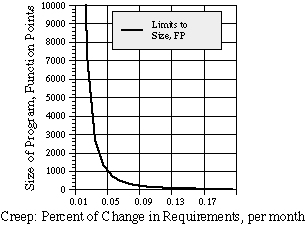 Figure. 2. Maximum program size, measured in function
points, versus the monthly rate of change in requirements. |
digital darwinism
 1
2
3
4
5
6
7
8 1
2
3
4
5
6
7
8
 Daily Dose Index |