 day 13
| the next big thing 5: fry's big season | 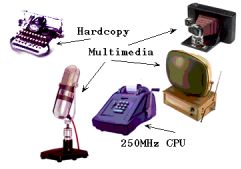
|
|
What sort of Box must Buck and his Silicon
Valley cohorts make now? What sort of Box will Fry's computer supermarket be selling for Christmas 1998? Make a better mouse, and a herd of nerds will trample you on their way to Fry's. After lunch they will flood the 1-800 lines to purchase peripherals and software. (Never mind the billions of hits that will be made on the Internet.) This is going to take many tricks of marketing, packaging, and an entirely new software industry. Packaging is the biggest challenge, because the $700 price point is all about packaging. The needed packaging trick is called multi-chip modules. Hardware designers use this technology to build entire systems out of sandwiched layers of silicon; they are "multi-chip" because they are essentially complete subsystems that have been squeezed together to form one big clump. A multi-chip module might incorporate a processor, multimedia (sound, video, telephony) processor, glue chips, I/O controllers, compression hardware, 3-D graphics accelerator, etc. Throw away the motherboard. Discard the special circuits that control I/O, eliminate the TCP/IP (Internet) connection chip set, crush the 3-D graphic board makers, and liberate the middleman. This is Intel's plan. This is the way to the $700 Box. The Intel MMX proposal is one example. After squabbling with Microsoft over who will rule the world, the MMX proposal is about to go into production. This is a standard and a product. It defines how multimedia will be played on the Box. It requires that Intel bludgeon the entire industry into accepting the "Intel way." No problem! Microsoft sees the future, and it is pronounced "small, cheap, and pervasive." So Microsoft re-boots its failed PDA (Personal Digital Assistant) project and code-names it Pegasus, anticipating the need for a lightweight, low-cost Windows95, something tidy that will work inside an Intel multi-chip module. Think of it as the cocktail before dinner. The Box is not really a computer. It is a TV, telephone, and VCR in disguise. With the 1996 Telecom Bill passed, just about anyone can wonder in off the streets and sell homeowners cable TV devices which were previously outlawed. Maybe this explains why Intel is interested in making CATV modems that will deliver Internet to your TV at 10 Mbps. Maybe this is why the cable companies are getting friendly with the telephone companies. The Box is not HDTV. HDTV is dead. In its place is HTML/VRML - the combination of webserver data and 3-D graphics. These two will be the asphalt that paves the information superhighway. They will evolve into a replacement for NTSC (TV signal format) and PAL (the format in Europe). Therefore, the Box will deliver TV in the form of compressed HTML/VRML. And, while Intel and Microsoft are at it, why not provide telephone services, music, postal delivery, education, and banking, all through the same Box? Buck's job is to save the world by saving Silicon Valley from a fate worse than death - loss of profits. Educated in India, Buck will now start producing millions of Boxes for his native country to consume. When he succeeds, Buck will have aided the capitulation of the entire globe to the creativity, standards, products, and whims of the Silicon Valley. The 21st century belongs to Buck.
|
the next big thing:
 1
2
3
4
5 1
2
3
4
5
 Daily Dose Index |