 day 103
|
alice in wired world 7: the positive feedback of the software economy |
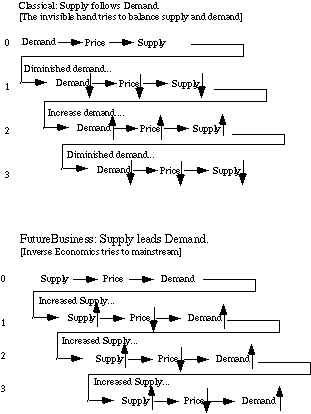
Figure 1. Classical vs. FutureBusiness economies.
Yesterday: Something other than Keynes works
for FutureBusiness.
economy from classical economics is the concept
of a positive feedback mechanism that operates
in the software age. It behaves just the
opposite of friction, or negative feedback in
classical economics. Here is how it works.
Simplified diagrams of Keynesian versus
non-Keynesian economics is shown in Figure 1.
the manufacturer waits for demand to rise or
fall before adjusting production. This delay
introduces cycles and uncertainty into
forecasting, and eventually into the
supply/demand balance. In effect, adjusting the
price point of a product in response to supply,
produces a kind of drag or negative feedback on
future supply.
equation is solved by initially estimating
demand, setting a price, and then producing the
product or service. At some later time (step
1, 2, ...), market feedback is used to adjust
demand estimates which results in cranking
production up or down. If the warehouse is
overstocked, the perception is that demand has
diminished, so the price is lowered to clear
out the inventory -- production is curtailed,
leading to less supply. Conversely, if demand
is great, manufacturing and prices are stepped
up to balance supply with demand. This takes
time, hence a delay is introduced which leads
to oscillations.
book-to-bill ratio drops below 1.0,
manufacturers decrease supply. When the ratio
exceeds 1.0, supply is increased, and sometimes
prices are, too (especially in the DRAM market
space). Adjustments and their corresponding
delays have produced cycles of up and down.
This keeps captains of the semiconductor
industry awake at night, so they have adopted a
rule which partially moderates cycles:
adjustments are kept in a range of plus or
minus 20% per year.
reverses this order -- demand effortlessly
follows production. This leads to a radically
different result. A company either mainstreams
or dies. There is little in between.
[Everything is fast in the software age,
remember?]. How does this work?
|
alice in wired world
 1
2
3
4
5
6 1
2
3
4
5
6
 Daily Dose Index |