 day 25
| artisans of the electrosphere 2: cowboys and suits |
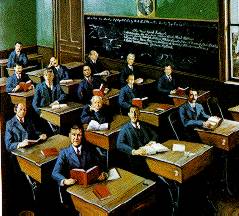 "The New York School" Andrew Gates, 1989
During the rise of software development as
a profession, a few advanced thinkers got
together at the NATO Conference on Software
Engineering in 1968 and decided that programming
ought to become a scientific and/or engineering
discipline. They coined "software engineering" to
separate themselves from the Bucking Bronco
cowboys who were coding most programs without
a clue.
software cowboys like Bucking Bronco for
failing to take a methodical approach to
designing next-generation systems. They
equated method with professionalism. If you did
not heed their advice, you were branded an
unwashed crafts-person of indeterminate
pedigree. In other words they unleashed a holy
jihad on anyone who used the word "artist" and
"software" in the same sentence.
should be more like designing buildings,
building bridges, or laying bricks and mortar.
That is, it ought to be a profession like, say,
engineering. Call such "engineers" the "suits,"
because IBM's interpretation of the software
engineer required programmers to don a white
shirt and black tie before showing up to collect
a paycheck.
programmer. IBM was one of the first
companies to jump on this bandwagon,
proclaiming radical productivity leaps from
the application of software engineering
principles. Andrew Gates's painting of the "New
York School" says it all - the IBM school of
structured programming was to revolutionize
software development, wipe out the cowboys,
and establish programming as a respectable
profession.
academics thought. In the next few decades,
IBM lost control of the computer industry to
Microsoft. Microsoft turned the programmer into
something entirely unexpected. In tomorrow's
episode, we reveal the first glimpse of the
future of programming.
|
artisans of the electrosphere:
 1
2
3
4
5 1
2
3
4
5
 Daily Dose Index |