 day 28
| artisans of the electrosphere 5: the rising software industry |
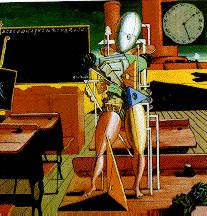 "The School of de Chirico" George Deem, 1993
What will become of programming?
rather than simply a big company. The only
equivalent in the software business is
Microsoft, because Microsoft is part of an
industry too, rather than simply a big company.
This important idea has been overlooked by many
pundits.
thing as a software industry. Instead, there
was mainly a bunch of companies competing with
one another, offering proprietary, incompatible,
and competitive products. It was as if Ford
Motor Company built cars with levers while GM
built them with steering wheels, and Chrysler
used push buttons. A Ford part still does not
always fit onto a Chrysler or Chevy, but all
autos run on the same roads, use standard
wheels, standard fuels, and depend upon the same
suppliers that form a very large infrastructure
called "the automobile industry".
AN INDUSTRY HAS PRODUCTION CAPACITY.
Office; more importantly, Microsoft paves the
software economy with production capacity. This
production capacity is a consequence of the
establishment of supply and demand inside
of the computer industry. There are over 60,000
third-party developers that run on the highway
paved by Microsoft. If any other single feature
of Microsoft can explain its success, it is
this: Microsoft makes room for its (potential)
competitors.
products created by Microsoft are incomplete.
They need additions. All of Microsoft's
operating systems need applications. Microosft
and others create applications for these
operating systems. Furthermore, Microsoft's
applications (such as Office) are themselves
incomplete. Many third party developers are
needed to "fill in the gaps" of these products.
Finally, Microsoft has learned how to become an
infrastructure company. Its OLE and ActiveX
infrastructure creates production opportunities
for thousands of the Microsoft groupie companies
that follow Microsoft technology roadmaps as if
they were the route to the promised land.
Macintosh is a total solution to all of your
computing needs." For the most part, there is
little that can be added to a Mac without coming
into direct competition with Apple. This leaves
little room for an industry to spring up around
the Mac.
This is Apple's weakness. While it is not
entirely true that the Mac is a complete
solution, it is true enough that the Mac has
failed to find a mainstream audience. The
third-party developers needed to sustain a
"Macintosh industry" simply did not materialize.
software industry.
CONSUMERS AND PRODUCERS. IF THE RISING SOFTWARE BUSINESS IS TO BECOME A TRUE INDUSTRY, IT MUST EVOLVE TOWARDS A COMMUNITY OF PRODUCERS AND CONSUMERS.
the electrosphere? The artisans of the
electrosphere will be the software producers
that emerge as software businesses evolve into
an industry. In the future, only a talented few
will be creative enough to produce software.
Maybe 500,000 artisans is all we need. Millions
of consumers will consume the creative products
of these artisans.
OMG's CORBA, and CILabs' OpenDoc are the
most-likely candidates to lead the transformation.
of the individual in art. Similarly, a very small
group of artisans will produce software
components for reuse by the consuming masses.
Like the great artists of the past, the software
artisans of the future will be few and far
between. But the number of consumers will swell
into millions. This is the way it has always
been; why should the software age be any
different?
|
artisans of the electrosphere:
 1
2
3
4
5 1
2
3
4
5
 Daily Dose Index |