 day 26
| artisans of the electrosphere 3: cowboys and artists |
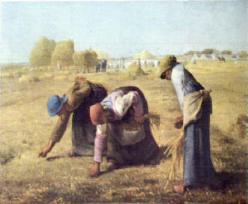 "The Gleaners" J-F. Millet 1857
IBM led the entire computer industry down a
rabbit hole called software engineering
throughout the 1980s. Millet's "The Gleaners"
says it all. Programming became a workman's
job: a skilled craft perhaps, but low-level and
menial nonetheless. Automation, CASE, code
generation, and a secret desire to rid
programmers from company overhead was the
tone of the 1980s.
to the downfall of IBM itself. Run by bean
counters and graduates from MBA programs, IBM
may have brought software engineering down with
it when management attempted to corral
programmers into the same fenced area as other
engineers. Paradoxically, these same MBA-trained
managers were headed for a showdown with
Harvard dropout Bill Gates.
classical engineers at IBM and many other
companies were spending National Science
Foundation grant money attempting to discover
the laws of software development, software
cowboys like Dan Bricklin (co-inventor of the
electronic spreadsheet), Bill Gates (co-inventor
of the software economy), and Gary Kildall
(deceased inventor of the first PC operating
system, CPM) roamed the electronic plains with
abandon. They ignored the formalisms and
dogmatic teachings of the academic world,
substituting creativity in their place. They
ignored the best-practices advice of formidable
companies such as IBM. These renegades of the
dawning software age were simply too busy to
notice.
created by artisans, not engineers. This is a
difficult daily dose to swallow, but the factual
data is in my favor. Look at the great software
inventions of all time, and you will notice one
common point: nearly all of them were created by
one or two artisans of the eletrosphere. How
many people developed C/C++, UNIX, Pascal,
MacOS, Relational Database, TCP/IP, HTML, and
HTTP? Not much of what we admire in today's
software is mass-produced on an assembly-line.
the artisans of the eletrosphere boost their
productivity? Or, do they need to? Stay tuned.
|
artisans of the electrosphere:
 1
2
3
4
5 1
2
3
4
5
 Daily Dose Index |