 day 106
| alice in wired world 10: inverse econ 101 |
|
Now, here is the non-Keynesian part.
Classical learning curves predict price declines (or an increase in quality) as the volume of produced goods doubles. This is the so-called theory of diminishing returns. But in the new software economy, the opposite is true -- volume production leads to increasing returns, according to new-age economists such as W. Brian Arthur ("The Theory That Made Microsoft", FORTUNE, April 29, 1996, p. 65-66). I call it the theory of inverse economics, Arthur calls it the theory of increasing returns. Here is how it works. Assuming true pricing (the price you pay is equivalent to the quality you get), the learning curve model predicts that the commodity-priced product will eventually overtake the premium-priced product simply because of higher production volumes. This is non-intuitive, because it says that if Toyota makes enough cars, eventually Toyotas will be both better and cheaper than Mercedes-Benz cars! Figure 2 illustrates the impact of inverse economics on premium/commodity market segments. For example, suppose a commodity producer manufactures 20 times as much product as a premium producer. This is indicated as a 20 on the vertical axis of Figure 2. If both manufacturers learn at the same industry rate, say B = 0.5, then (0.5, 20) represents the point at which both products are of equal quality. If the premium product initially sells for 5 times the price of a commodity product, it will eventually be no better in quality than a commodity product that sells 10 times as may units. The commodity product eventually catches up with the premium product. In a way, volume production allows the commodity-product to accelerate the learning curve needed to make a better and cheaper product. It is the superiority of mediocrity
over elitism.
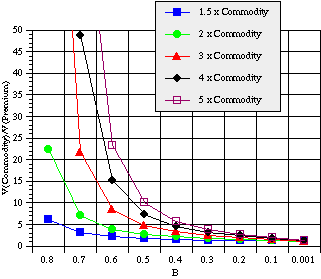
Volume Production of Premium-Priced product versus the learning rate parameter B. Recall that small values of B represent high learning rates, and high values represent low learning rates, 0<B<1.
|
alice in wired world
 1
2
3
4
5
6
7
8
9 1
2
3
4
5
6
7
8
9
 Daily Dose Index |